
1. About UPSC Civil Services Examination
The Civil Services Examination (CSE) is conducted by the Union Public Service Commission (UPSC) for recruitment to various prestigious services of the Government of India.
It is one of the most competitive examinations in India and serves as the gateway to administrative, diplomatic, police, and other key services responsible for governance and policy implementation.
The examination is conducted in multiple stages to assess a candidate’s knowledge, analytical ability, decision-making skills, and overall personality. Selection is based on performance in all stages of the examination.
2. Services Offered Through CSE
The Civil Services Examination recruits candidates for a wide range of Group ‘A’ and Group ‘B’ services under the Government of India.
All India Services
- Indian Administrative Service (IAS)
- Indian Police Service (IPS)
- Indian Foreign Service (IFS)
Group ‘A’ Services
- Indian Audit and Accounts Service
- Indian Civil Accounts Service
- Indian Corporate Law Service
- Indian Defence Accounts Service
- Indian Defence Estates Service
- Indian Information Service
- Indian Postal Service
- Indian Railway Management Services (Traffic, Personnel, Accounts)
- Indian Revenue Service (Customs & Indirect Taxes)
- Indian Revenue Service (Income Tax)
- Indian Trade Service
Group ‘B’ Services
- Armed Forces Headquarters Civil Service
- DANICS (Delhi, Andaman & Nicobar Islands Civil Service)
- DANIPS (Police Service)
- Pondicherry Civil Service
- Pondicherry Police Service
These services play a crucial role in administration, governance, law enforcement, diplomacy, and public service delivery.
3. Eligibility Criteria
Candidates must satisfy the prescribed eligibility conditions related to nationality, age, educational qualification, and other criteria. Admission to all stages of the examination is provisional and subject to verification.
3.1 Nationality
For All India Services such as IAS, IPS, and IFS, a candidate must be a citizen of India.
For other services, candidates may be:
- Citizens of India
- Subjects of Nepal or Bhutan
- Tibetan refugees who migrated before January 1, 1962
- Persons of Indian origin migrating from specified countries with the intention of permanent settlement in India
3.2 Age Limit
A candidate must have attained a minimum age of 21 years and must not exceed the upper age limit as prescribed by the Commission.
3.3 Age Relaxation
Relaxation in the upper age limit is provided for reserved categories and specific groups, including:
- Scheduled Castes (SC) / Scheduled Tribes (ST)
- Other Backward Classes (OBC)
- Defence personnel
- Ex-servicemen
- Persons with Benchmark Disabilities (PwBD)
The extent of relaxation varies based on category as per government rules.
3.4 Educational Qualification
A candidate must hold a graduate degree from:
- A recognized university established by an Act of Parliament or State Legislature, or
- An institution recognized as a deemed university, or
- An equivalent qualification recognized by the Government
Candidates appearing in their final year of graduation are also eligible, subject to fulfilling the qualification at later stages.
3.5 Number of Attempts
The number of attempts allowed depends on the category of the candidate:
- General category: Limited attempts
- OBC category: Additional attempts
- SC/ST category: No restriction within age limit
- PwBD candidates: Relaxation as per category rules
An attempt is counted when a candidate appears in any paper of the Preliminary Examination.
3.6 Medical Standards
Candidates must meet the prescribed physical and medical standards required for different services.
Medical examination is conducted as per the guidelines specified in the examination rules, and only those candidates who satisfy these standards are eligible for final appointment.
4. Exam Pattern
The Civil Services Examination consists of two stages:
- Preliminary Examination (Screening Stage)
- Main Examination (Written + Interview)
4.1 Preliminary Examination (Prelims)
The Preliminary Examination is an objective type screening test.
Structure:
- Number of Papers: 2
- Type: Multiple Choice Questions (MCQs)
- Total Marks: 400
- Duration: 2 hours each
Papers:
- General Studies Paper I
- General Studies Paper II (CSAT) – Qualifying (minimum 33%)
Key Features:
- Negative marking for incorrect answers
- Marks are not counted in final merit
- Used only for qualification to Mains
4.2 Main Examination (Mains)
The Main Examination is a descriptive (written) exam.
Structure:
- Total Papers: 9
- Type: Essay / Descriptive
Paper Breakdown:
- Paper A: Indian Language (Qualifying)
- Paper B: English (Qualifying)
- Paper I: Essay
- Paper II: General Studies I
- Paper III: General Studies II
- Paper IV: General Studies III
- Paper V: General Studies IV
- Paper VI & VII: Optional Subject (2 papers)
Key Features:
- Only 7 papers counted for merit
- Qualifying papers must be cleared
- Tests depth of understanding and writing ability
4.3 Interview / Personality Test
Candidates who qualify the Mains are called for the Interview.
Details:
- Marks: 275
- No minimum qualifying marks
Assessment Areas:
- Personality
- Decision-making ability
- Leadership qualities
- Awareness of current issues
Marks are added to Mains for final ranking.
4.4 Final Merit & Ranking
Final selection is based on:
- Marks in Mains (Written)
- Marks in Interview
Tie-Breaking:
- Higher marks in GS + Essay + Interview
- If still tied → older candidate ranked higher
5. Syllabus
The syllabus of the Civil Services Examination is designed to evaluate a candidate’s understanding of subjects relevant to governance, administration, and society. It includes both Preliminary (objective) and Main (descriptive) level topics.
5.1 Preliminary Examination (General Studies Paper I)
The General Studies Paper I in the Preliminary Examination tests a candidate’s basic awareness and conceptual clarity across multiple subjects.
Topics:
- Current events of national and international importance
- History of India and Indian National Movement
- Indian and World Geography
- Physical, Social, Economic Geography
- Indian Polity and Governance
- Constitution
- Political System
- Panchayati Raj
- Public Policy
- Rights Issues
- Economic and Social Development
- Sustainable Development
- Poverty
- Inclusion
- Demographics
- Social Sector Initiatives
- General issues on Environmental Ecology
- Biodiversity
- Climate Change
- General Science
5.2 Main Examination (General Studies Papers)
The General Studies papers in the Main Examination assess in-depth understanding, analytical ability, and application of knowledge.
GS Paper I – Indian Heritage & Society
- Indian culture
- Art forms, literature, architecture
- Modern Indian history
- Significant events, personalities, issues
- Freedom struggle
- Various stages and contributors
- Post-independence consolidation and reorganization
- History of the world (18th century onwards)
- Industrial revolution
- World wars
- Colonization and decolonization
- Indian society
- Diversity
- Role of women
- Population and associated issues
- Poverty and development issues
- Urbanization
- Effects of globalization on Indian society
- Social empowerment
- Communalism
- Regionalism
- Secularism
- Physical geography of the world
- Distribution of key natural resources
- Important geophysical phenomena
GS Paper II – Governance, Constitution & International Relations
- Indian Constitution
- Historical background
- Features
- Amendments
- Basic structure
- Functions and responsibilities of Union and States
- Separation of powers
- Dispute redressal mechanisms
- Parliament and State Legislatures
- Structure, functioning, powers
- Executive and Judiciary
- Representation of People’s Act
- Constitutional and statutory bodies
- Government policies and interventions
- Welfare schemes for vulnerable sections
- Issues relating to poverty and hunger
- Social sector services
- Health
- Education
- Governance
- Transparency
- Accountability
- E-governance
- Role of civil services
- India and its neighbourhood relations
- International relations and organizations
GS Paper III – Economy, Environment, Science & Security
- Indian Economy
- Planning
- Growth and development
- Inclusive growth
- Government budgeting
- Agriculture
- Cropping patterns
- Irrigation
- Food security
- Infrastructure
- Energy
- Transport
- Science and Technology
- Developments and applications
- IT, Space, AI, Robotics
- Environmental conservation
- Pollution
- Climate change
- Disaster management
- Internal security
- Terrorism
- Cyber security
- Border management
GS Paper IV – Ethics, Integrity & Aptitude
- Ethics and human interface
- Human values
- Attitude
- Aptitude and foundational values
- Integrity
- Impartiality
- Objectivity
- Emotional intelligence
- Moral thinkers and philosophers
- Public service values
- Probity in governance
- Case studies on ethics
6. Indian Polity – Weightage, Importance & Strategy
Indian Polity is one of the most important subjects in the Civil Services Examination, forming a core part of both the Preliminary and Main stages. It plays a crucial role in building a strong foundation for governance, constitution, and current affairs-based questions.
6.1 Importance of Indian Polity
- One of the most scoring and predictable subjects
- Directly linked with the Indian Constitution and governance system
- High overlap between Prelims, Mains, and Interview
- Helps in understanding current affairs and government policies
- Conceptual clarity ensures better performance across papers
6.2 Weightage in Preliminary Examination
Indian Polity consistently holds a significant share in the Preliminary Examination.
Expected Weightage:
- Approximately 12–18 questions every year
- Around 25–30% of GS Paper I
Nature of Questions:
- Concept-based (Constitutional provisions)
- Static + current affairs mix
- Increasing focus on analytical and application-based questions
6.3 Weightage in Main Examination
Indian Polity forms a major portion of General Studies Paper II (GS-II).
Coverage:
- Major part of GS Paper II
- Also overlaps with Essay and Ethics (GS-IV)
Key Areas:
- Constitution
- Governance
- Parliament & State Legislatures
- Judiciary
- Federalism
- Welfare schemes
- International relations (partial overlap)
6.4 Key Topics in Indian Polity
Core Areas:
- Historical background of the Constitution
- Salient features of the Constitution
- Fundamental Rights, Duties, DPSP
- Union & State Government
- Parliament and State Legislature
- President, Prime Minister, Governor, Chief Minister
- Judiciary and Judicial Review
- Federal structure and Centre-State relations
- Constitutional & Non-Constitutional Bodies
- Emergency provisions
6.5 Preparation Strategy
For Prelims:
- Focus on concept clarity + factual accuracy
- Practice MCQs regularly
- Revise articles and provisions
For Mains:
- Develop answer writing with examples
- Link static concepts with current affairs
- Use constitutional articles in answers
6.6 Why Indian Polity is a High-Return Subject
- Limited syllabus → high return on effort
- Static nature → easy to revise multiple times
- Strong overlap → covers Prelims + Mains + Interview
- High scoring potential compared to other subjects
7. How Mantra IAS Master Course on Indian Polity Helps You
The Indian Polity section in the Civil Services Examination requires strong conceptual clarity, repeated revision, and the ability to apply constitutional concepts in both objective and descriptive formats.
The Mantra IAS Master Course on Indian Polity is designed to simplify this preparation by providing a structured, exam-oriented approach aligned with the requirements of both Prelims and Mains.
7.1 Complete Coverage of Syllabus
The course provides comprehensive coverage of the entire Indian Polity syllabus, including:
- Constitutional framework and evolution
- Fundamental Rights, Duties, and DPSP
- Parliament, Judiciary, and Executive
- Federalism and Centre-State relations
- Constitutional and statutory bodies
Each topic is explained in a structured manner to ensure clarity and retention.
7.2 Concept-Based Learning Approach
Instead of rote learning, the course focuses on:
- Building strong conceptual understanding
- Linking static topics with current developments
- Explaining complex provisions in a simplified manner
This helps in solving both conceptual Prelims questions and analytical Mains questions effectively.
7.3 Integrated Preparation for Prelims & Mains
The course is designed as a single integrated program covering:
- Objective concepts for Prelims
- Analytical understanding for Mains
- Answer writing orientation
This eliminates the need to study the same subject separately for different stages.
7.4 Previous Year Questions (PYQ) Integration
Special focus is given on PYQs to help students:
- Understand question patterns
- Identify important areas
- Improve exam-oriented preparation
Topics are aligned with PYQs to ensure relevance.
7.5 Structured Revision Framework
The course is designed to support multiple revisions through:
- Topic-wise breakdown
- Clear conceptual notes
- Focus on high-weightage areas
This ensures better retention and recall during the exam.
7.6 Exam-Oriented Preparation Strategy
Students are guided on:
- How to approach different types of questions
- How to eliminate options in Prelims
- How to structure answers in Mains
- How to use constitutional articles effectively
7.7 Designed for All Aspirants
The course is suitable for:
- Beginners starting from scratch
- Repeaters looking to strengthen weak areas
- Aspirants targeting both Prelims and Mains
- Mains
- Prelims
- Syllabus
- UPSC
- UPSC CSE 2025
- UPSC GS Paper 1
- UPSC GS Paper 1 Question Paper
- UPSC Official Answer Key 2025
- UPSC Prelims 2025
- UPSC Question Paper 2025
- UPSC Question Paper PDF
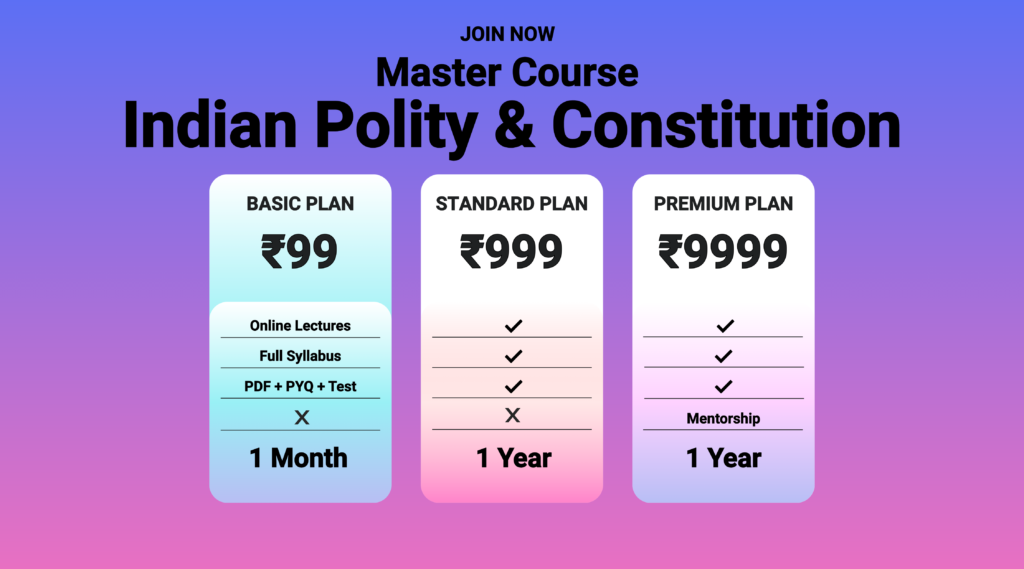

Rs 99 Offer
Basic Plan